Parking Lot Concrete Leveling
Detroit parking lot leveling — pre-job assessment, traffic-control plan, lift sequence, joint sealing follow-up, post-job inspection and warranty.
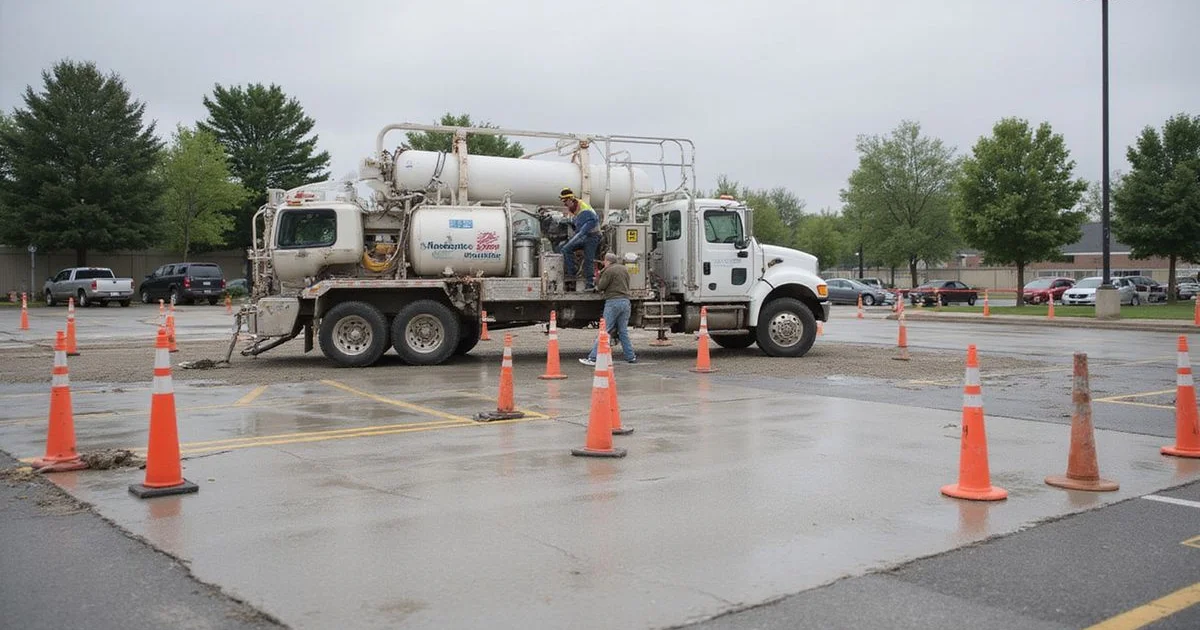
You know how quickly a single sunken slab can turn from a minor nuisance into a major liability for Detroit retail, office, and HOA properties. Property managers constantly juggle the need for safe surfaces with the demand to keep lots fully operational.
At Concrete Leveling Detroit, we regularly see that proactive commercial parking lot repair is the dividing line between a well-maintained property and a costly lawsuit. Here is what you can expect from a professional service.
Our team is going to break down the standard parking lot concrete leveling process for US properties. This guide explains how to eliminate any parking lot trip hazard while keeping your business running smoothly.
What happens during the pre-job assessment for parking lot concrete leveling?
We start every project by identifying the exact scope of the damage. A thorough inspection evaluates slab conditions, ADA compliance, and drainage before any work begins.
Our team conducts a detailed walk-through to map out the specific problem areas. This initial phase focuses on four critical evaluations.
- Slab inventory: Identifying which slabs are settling and measuring the exact drop.
- ADA-compliance audit: Checking height differentials at curb cuts and walkways. The US Americans with Disabilities Act strictly defines any vertical change over 1/4 inch as a parking lot trip hazard. Ignoring these 1/4-inch offsets can trigger Department of Justice civil penalties up to $15,000 for a first violation in 2026.
- Drainage inspection: Looking for pooling water and void formation underneath the surface.
- Lift sequence planning: Determining which slabs require lifting first to ensure structural stability.
How does the traffic-control plan work?
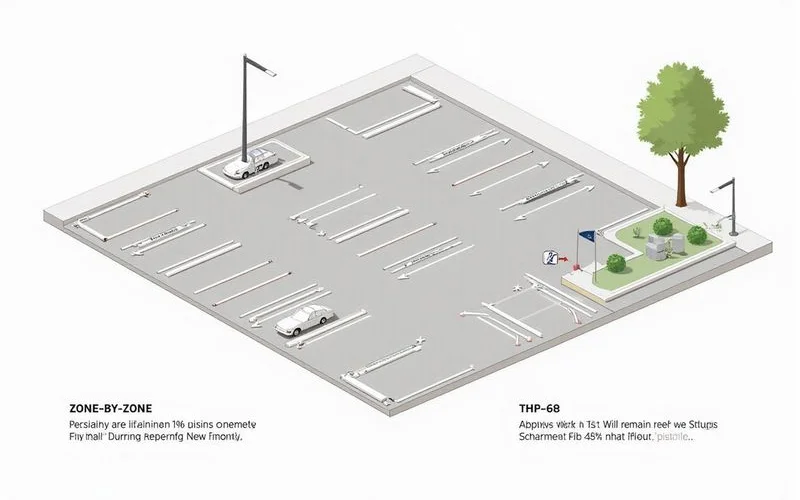
Closing an entire commercial lot is rarely a viable option. You can expect a stall-by-stall approach that isolates small work zones while keeping the majority of the lot open.
Our targeted strategy minimizes disruption while the crew works safely. This precise isolation ensures your daily operations barely miss a beat.
- Cones isolate the work zone: Barricades clearly mark the active repair area.
- Adjacent stalls remain open: Vehicles can safely park right next to the work zone.
- Most lots stay 70%+ operational: High-traffic retail centers maintain the vast majority of their capacity during work.
- Customer traffic flows: Cars move easily through unaffected zones without complicated detours.
We schedule these isolated zones strategically to match your peak traffic hours. Modern polyurethane materials cure extremely fast.
Our clients typically see vehicles driving over newly lifted concrete just 15 to 25 minutes after the injection process finishes. Fast curing speeds keep tenant complaints to an absolute minimum.
What is the standard lift sequence?
We work zone-by-zone or stall-by-stall depending on the size of your property. The standard progression involves drilling small ports, injecting the expanding foam, and patching the holes.
Our technicians execute these precise steps to ensure a permanent fix. Each zone follows a highly controlled procedure to restore the surface quickly.
- Drill 3/8-inch ports: The crew drills tiny holes directly into the sunken slab.
- Inject limestone-foam mix: A specialized pump pushes the expanding mixture beneath the concrete. This high-density material expands up to 20 times its liquid volume to compress loose soil.
- Lift to grade: The rapid expansion hydraulically pushes the slab back to its original elevation.
- Patch and verify: Technicians fill the small drill holes with a color-matched non-shrink grout and check the final height.
- Open zone, move to next: The fast 15-minute cure time allows immediate reopening for vehicle traffic.
Why is joint sealing follow-up recommended?
This final protective step prevents water from seeping under the newly lifted slabs. Unsealed expansion joints allow rain and melting snow to penetrate the subgrade.
Our crews apply commercial-grade hot-pour polyurethane or silicone sealants to block this moisture. Water infiltration causes soil erosion, which is the root cause of 90% of settling issues.
Proper joint sealing stops this erosion cycle completely. You can learn more on our joint sealing service page.
What is included in the post-job inspection and warranty?
Transparency and accountability define a successful commercial project. You will receive a written elevation report, pre-and-post photos, and a multi-year warranty against future settling.
Our final walkthrough verifies every measurement against the initial project scope. Every lot includes specific deliverables to protect your investment.
- Written elevation report: A detailed log showing the corrected slab heights.
- Photos of pre-and-post conditions: Visual evidence of the eliminated trip hazards.
- Certificate of insurance: Documentation that protects your property during the repair.
- Written warranty against settling: Most commercial applications include a multi-year guarantee under normal use.
We provide this documentation immediately upon project completion. Property managers use these records to demonstrate proactive maintenance during ADA compliance audits.
How does scheduling work for commercial properties?
Finding the right time for repairs requires flexibility to avoid disrupting your business. The fast curing speed of modern leveling materials provides multiple ways to plan your project.
Our logistics team works directly with property managers to eliminate daytime bottlenecks. Typical scheduling focuses on avoiding peak operational hours.
We offer several timeline options to match your specific requirements. The most common schedules include the following timeframes.
| Scheduling Option | Best For | Typical Impact |
|---|---|---|
| After-hours weeknight starts | Busy retail centers and restaurants. | Avoids customer traffic entirely. |
| Saturday or Sunday | Office parks and corporate centers. | Allows for full-lot work while empty. |
| Multi-week phased schedules | Very large lots or HOA communities. | Keeps the majority of parking open daily. |
Cost-effective concrete leveling saves you 50% to 70% compared to a full slab replacement. This massive cost reduction makes weekend or phased scheduling highly beneficial for extensive properties.
Proper parking lot concrete leveling eliminates safety risks and extends the life of your pavement without the massive expense of a full replacement.
Our team is ready to evaluate your site and recommend the best course of action. You can find more details in our commercial concrete leveling service and property managers’ maintenance checklist.
Common Questions
Quick answers from our Metro Detroit crew.
How disruptive is the work?
Should we seal joints right after?
More from this topic
Commercial Leveling vs. Replacement: Cost & Downtime
Total cost of ownership: job cost + downtime + lost productivity. Insurance considerations. Multi-phase scheduling. Detroit commercial.
Cost of Commercial Concrete Leveling in Michigan
Pricing factors: square footage, slab thickness, access, after-hours premium. Typical project ranges and RFP guidance for Detroit B2B.
Property Manager's Concrete Maintenance Checklist
Annual inspection checklist, freeze-thaw prep timing, joint reseal schedule, void inspection cadence — by property type. Free download.
Have a slab to lift? Let's take a look.
Free, no-obligation on-site estimate. If we can't fix it, you don't pay.