When a New Pour Beats Repair
Crumbled slabs, missing concrete, structural failure — when leveling won't work and a fresh pour is the right call. Honest qualification.
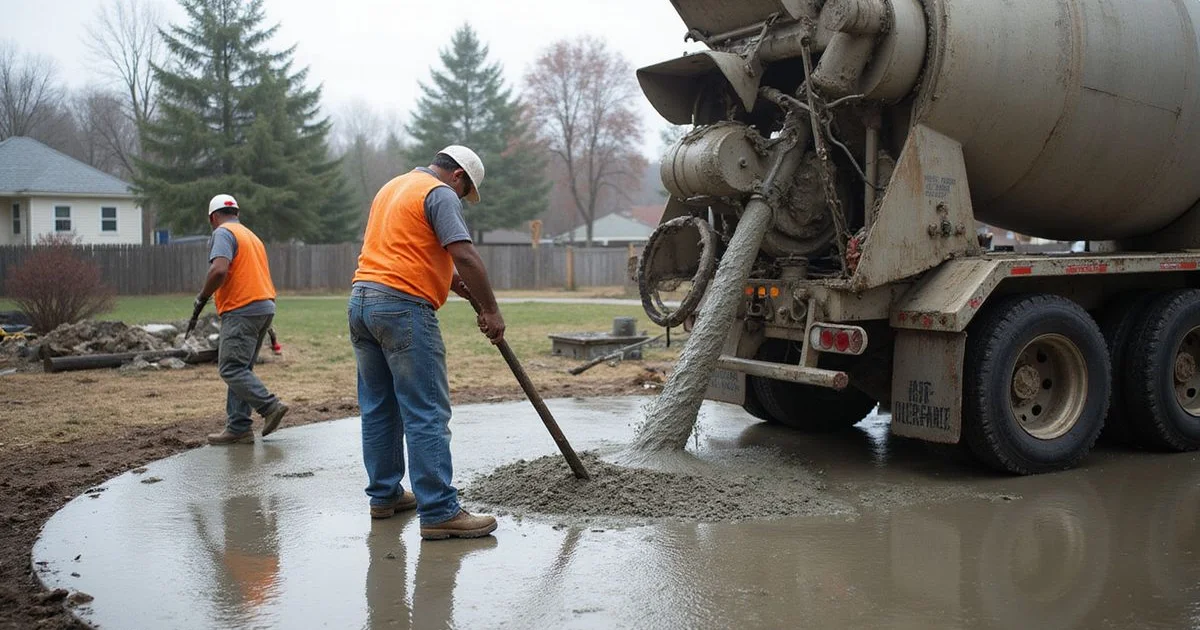
We would rather lift than pour, but patching a structurally compromised foundation is usually just a temporary bandage. From what I have seen restoring properties across Detroit, a quarter-inch crack is often the dividing line between a simple fix and a necessary replacement.
Our goal is to help you understand exactly when to pour new concrete instead of attempting a doomed repair.
This guide breaks down the true cost differences of a small concrete pour vs repair, what to expect during installation, and the signs that your slab needs a complete replacement.
When new concrete beats repair
Crumbled slabs beyond patching
Heavy spalling, missing chunks, and exposed reinforcement bar mean that patching will not hold. The slab needs to come out completely.
Our technicians look for surface pitting that extends deep into the core of the concrete. Resurfacing materials cannot bond properly to a crumbling base, making a full replacement the only viable option.
Missing concrete (gaps, broken sections)
Sections that have broken off and disappeared usually point to severe base erosion underneath. We cannot use leveling foam to restore concrete that simply is not there.
Fixing this requires completely removing the remaining damaged pieces. Our installation process involves laying a brand new pour to stabilize the soil and create a solid surface.
Structural failure
Through-cracks running across reinforcement and pieces moving independently when stepped on show that the slab is mechanically broken. Our rule of thumb is that cracks wider than a quarter of an inch indicate active foundation shifting.
Choosing a new concrete vs repair is mandatory here because pumping material under a shattered slab will not reconnect the broken pieces. We always recommend full replacement when the structural integrity is this severely compromised.
What we handle in new pour scope
Our standard service list covers the most common property issues without requiring heavy commercial equipment. Focusing on these specific residential projects allows for faster scheduling and precise quality control.
We regularly tackle projects that improve both safety and curb appeal. These targeted solutions include the following core services:
- Sidewalk patches and section replacement
- Small residential pads for heavy equipment like HVAC units, generators, or 10x10 shed bases
- Step landings and porch reconstruction to fix severe tripping hazards
- Single-slab driveway section pours where only one panel has failed
- ADA ramp pours to ensure strict accessibility compliance
What we don’t handle
Large new construction projects like full driveways, massive patios, or entirely new pool decks require different machinery. We focus exclusively on precision restoration and small-scale pouring.
A full two-car driveway typically requires a full truckload of eight to ten cubic yards of material. Our team refers these massive jobs to a trusted local pour crew equipped with high-volume mixing trucks.
Expected cost for small-scale pours
Most small-scale pours run $1,200 to $6,000 total. Our data shows national averages for small projects currently ranging between $5 and $18 per square foot in 2026.
Pricing for concrete relies heavily on the volume of material and the complexity of the site preparation. We calculate several specific factors to give you an accurate, transparent quote.
| Cost Factor | Why It Matters |
|---|---|
| Short-Load Fees | Suppliers typically add about $40 per cubic yard for orders under a full ten-yard truckload. |
| Sub-base Preparation | Eroded soil requires new compacted gravel before any pouring happens. |
| Form Complexity | Curved edges or custom shapes require more labor to build the wooden forms. |
| Finish Requirements | A standard broom finish costs less than smooth, stamped, or sealed designs. |
Scheduling and finish options
We typically complete small residential pours in a single working day. Understanding the curing timeline is critical to preventing accidental damage to your new investment.
Our crews follow the industry standard rule of thumb, meaning concrete reaches 70 percent of its 3,000 PSI strength in seven days. This timeline dictates exactly when the surface is safe to use.
| Cure Stage | Timeline | Safe Activity |
|---|---|---|
| Initial Set | 24 to 48 hours | Cure to walkable. Safe for light foot traffic and pets. |
| Moderate Strength | 5 to 7 days | Cure to driveable. Safe for standard 3,000-pound sedans. |
| Full Strength | 28 days | Achieves 100 percent PSI. Safe for heavy trucks and RVs. |
The standard finish is a simple broom texture, which provides the best slip resistance for outdoor use. We also offer optional finishes like smooth troweling, decorative stamping, and professional sealing.
For service details, see our new concrete installation page and the case where leveling does fit, driveway leveling vs replacement.
Request a free estimate to secure pricing for your specific project.
Common Questions
Quick answers from our Metro Detroit crew.
Will you talk me out of a new pour if leveling works?
What's the smallest pour you'll do?
Have a slab to lift? Let's take a look.
Free, no-obligation on-site estimate. If we can't fix it, you don't pay.