How Concrete Leveling Works
Detroit's 4-step concrete leveling process: assess, drill 3/8-inch ports, inject limestone-foam, patch. Same-day return-to-use, no demolition.
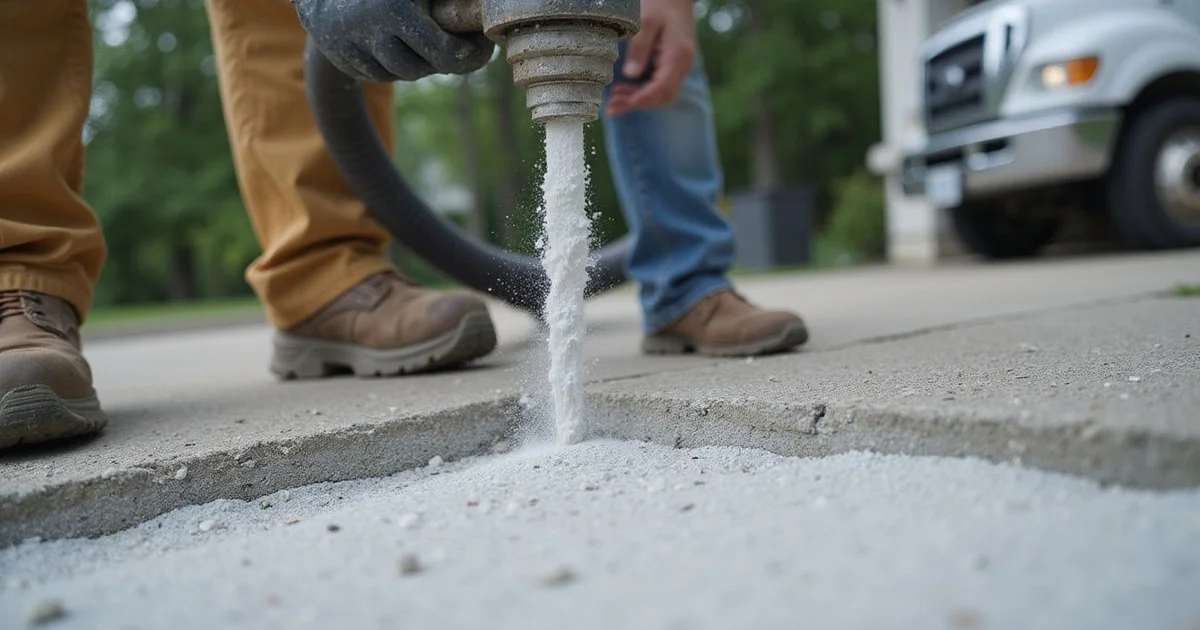
We know how frustrating a sunken driveway or unlevel pool deck can be. Many homeowners assume ripping out the old slab is the only option. Replacing a patio can cost thousands of dollars and tear up your yard for weeks.
When looking at the damage, you naturally wonder, how does concrete leveling work to fix this without heavy demolition? Our team relies on a straightforward four-step concrete leveling process to lift sunken slabs back to proper grade.
Let’s look at the data, see what causes these issues, and walk through exactly what happens on a typical Metro Detroit job.
Step 1: Free on-site assessment
We start every job with a comprehensive site walk to measure the settled area and diagnose the root cause. This initial inspection is completely free and comes with no obligation.
Our estimator actively looks for signs of clay soil settlement, soil washout, or freeze-thaw void formation. Southeast Michigan soil is notorious for frost heave during our harsh winters. Water freezes beneath the surface, expands by 9 percent, and pushes the slab up, only to leave an empty void when it melts.
Let’s look at the top causes of sunken concrete we see locally:
- Clay soil consolidation over time
- Rapid washout from poor gutter drainage
- Freeze-thaw cycle voids causing instability
Then we write a detailed quote on-site. If your slab cannot be safely lifted, you owe us absolutely nothing. This is our strict no-fix, no-charge guarantee.
Step 2: Drill 3/8-inch ports
If the project proceeds, we drill small 3/8-inch injection ports directly through the settled slab. These tiny holes are roughly the diameter of a standard pencil.
This approach is far less invasive than traditional mudjacking methods. Old-school mudjacking leaves massive 1.5-inch to 2-inch holes scattered across your beautiful driveway.
Consider this quick comparison of concrete leveling methods:
| Method | Hole Diameter | Visual Impact |
|---|---|---|
| Traditional Mudjacking | 1.5 to 2.0 inches | Highly noticeable patches |
| Modern Poly/Limestone | 3/8 inch | Practically invisible |
Drilling takes only a few minutes per port and generates minimal dust. Workers place extra ports near the deepest voids for maximum lift efficiency. Your adjacent landscaping and garden beds stay completely protected throughout this quick step.
Step 3: Inject limestone-foam mix
We pump our Michigan-exclusive 100% limestone-and-foam hybrid through the ports under controlled pressure. This precise step demonstrates slab lifting how it works in real time.
The dense limestone material fills large volume areas and aggressively resists washout from heavy rain. A high-density polyurethane foam additive expands to stabilize the mix and fill tiny crevices that regular slurry misses.
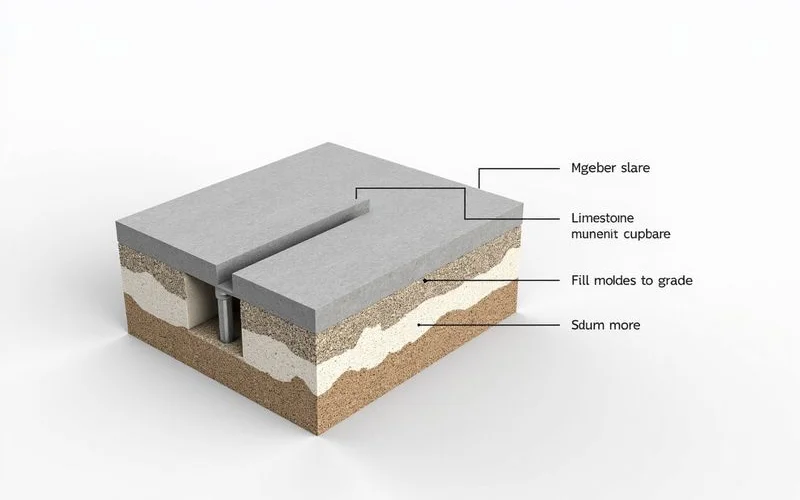
High-density lifting foams are incredibly powerful and can exert up to 6,000 pounds of lifting force per square foot. The slab literally rises right before your eyes. Our project estimator constantly monitors the lift progress using precision measuring tools.
This careful monitoring prevents overshooting the grade level and ensures a perfectly flush surface. Most average-sized residential patios are perfectly level within a single hour of starting the injection.
Step 4: Patch and final QC
Once the lift finishes, we patch the injection ports using a color-matched non-shrink grout. These small patches cure rapidly and become virtually invisible from just a few feet away. Final quality control ensures your project meets strict safety and performance standards.
Our final QC checklist includes:
- Re-measuring the lifted area to verify perfect grade matching
- Testing drainage flow to ensure water runs away from your foundation walls
- Walking the control joints to confirm zero slab movement
- Documenting the completed work for your written warranty records
Most homeowners can safely park a 4,000-pound car on the driveway the same evening. Normal foot traffic is perfectly fine within just one hour of the patching step. Same-day return-to-use is the absolute norm, not the exception.
Why same-day cure is possible
Both our limestone-foam mix and the pure polyurethane foam use advanced fast-set chemistry. The polyurethane material reaches an impressive 90 percent of its working strength in just 15 minutes.
The limestone-foam hybrid achieves full load-bearing capacity within a few hours. This rapid turnaround is significantly faster than the agonizing 28-day cure curve required for a fresh concrete pour.
Here is a quick look at typical cure times:
| Material Type | Time to Foot Traffic | Time to Vehicle Traffic |
|---|---|---|
| Fresh Concrete Pour | 24 to 48 hours | 7 to 28 days |
| Limestone-Foam Hybrid | 1 hour | 4 to 6 hours |
We are simply stabilizing the existing material rather than starting a messy fresh pour. Replacing a slab requires heavy demolition, hauling away tons of rubble, and setting wooden forms.
Leveling eliminates the demolition phase entirely and utilizes lightweight, modern materials. Traditional mudjacking slurry weighs roughly 120 pounds per cubic foot. Our hybrid foam mix weighs just 2 to 4 pounds per cubic foot, putting zero extra stress on weak, underlying soil.
What you do during the job
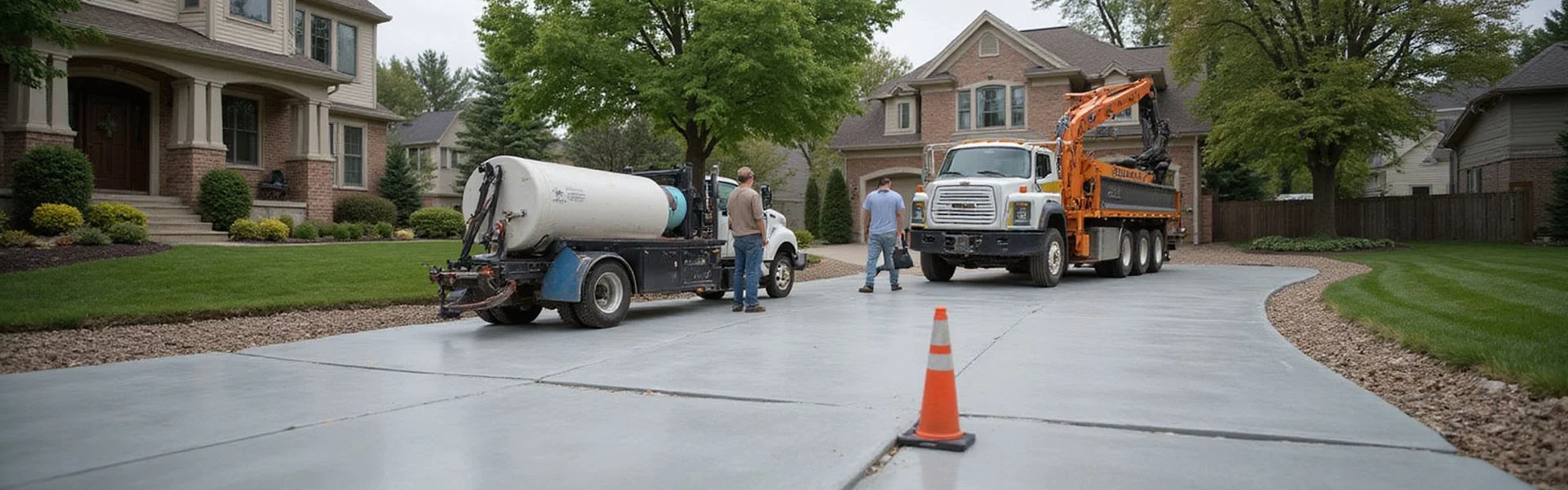
You actually do almost nothing while our professional crew works on your property. Simply move vehicles out of the immediate work zone and clear access around the main slab edges.
The average job noise level is extremely manageable for a quiet residential neighborhood. A standard hammer drill registers around 100 decibels for brief seconds, unlike a sustained 130-decibel jackhammer used for total replacement.
Most clients just go about their normal day inside the house. The entire concrete leveling process causes zero interruption to your home utilities.
For service-specific deep dives, please see our complete driveway leveling process step-by-step, read through the polyurethane foam injection page, or visit the limestone slab-jacking page.
You deserve a safe, hazard-free property without the headache of full replacement. Ready to start your repair? Request a free estimate today.
Common Questions
Quick answers from our Metro Detroit crew.
How long does the whole process take?
Is concrete leveling messy?
Can you level a slab in winter?
More from this topic
How Much Does Concrete Leveling Cost in Michigan?
Real Michigan concrete leveling prices by slab type and depth. See what drives cost, how it compares to replacement, and our no-fix-no-charge guarantee.
Concrete Leveling vs. Replacement: Which Is Right?
Compare concrete leveling vs. full replacement: cost, downtime, and when each makes sense in Metro Detroit. Honest guidance, no upsell.
Concrete Leveling vs. Foundation Repair: When You Need Each
Slab leveling addresses sunken concrete; foundation repair addresses structural settlement. A clear decision tree, with honest referrals when needed.
Have a slab to lift? Let's take a look.
Free, no-obligation on-site estimate. If we can't fix it, you don't pay.